Lacrosse in the UK: rules, four formats, history and the road to LA28
Lacrosse is a team sport in which players use a stick with a netted head, the pocket, to catch, carry and pass a solid rubber ball and shoot it into the opposing goal. It is played outdoors as men's and women's field lacrosse and as the short-sided Sixes, and indoors as box lacrosse, inside a rink ringed by dasher boards.
- Men's field
- 10a side, outdoors
- Women's field
- 10a side at most, international rules
- Box
- 6on the floor, indoors
- Sixes
- 6a side, the LA28 format
What is lacrosse, and why does the stick do everything?
The shortest answer to what is lacrosse: a game about moving a ball with a stick. The stick ends in a head strung with mesh or traditional stringing, and the shallow bag that forms inside it is the pocket. Players cradle the ball there while running, pass it across the pitch and shoot at a goal guarded by a goalkeeper.
Outfield players do not play the ball with their hands, so every skill in the game runs through the stick: catching on the move, scooping a loose ball off the ground, protecting it from a defender and releasing it quickly enough to beat the goalkeeper.
The game is fast, since play swings from end to end without long stoppages, and it is tactical too. Attacks set up shapes around the goal, defenders push shooters to poor angles, and every restart is contested.
The modern versions share the stick, the ball and the goal but differ in team size, space, contact and pace.
The ball and the goal are the fixed points. The ball is solid rubber, about 20 cm round and weighing 142 to 149 g under the World Lacrosse rulebooks. The goal is a square frame 1.83 m (6 ft) high and wide with a pyramid-shaped net behind it, the same size in field lacrosse and in Sixes. Each goal sits inside a circular crease of 3 m radius that attackers may not enter.
Stick length is regulated, and it differs by game. In the men's field game a stick is either a short stick of 101.6 to 106.7 cm (40 to 42 in) or a long stick of 132.1 to 182.9 cm (52 to 72 in), and a team may have no more than four long sticks on the field at once, the goalkeeper's excepted. An outfield head must measure between 15.24 and 25.40 cm across at its widest point, while the goalkeeper's head may be up to 38.10 cm wide, and adjustable-length shafts are illegal.
Under the women's field rulebook a crosse is 90 to 110 cm long overall and weighs no more than 567 g, strung head and shaft together. Both documents are linked from the World Lacrosse men's rules and the women's field rulebook.
How do the four lacrosse formats differ?
Four formats are played today. They are not interchangeable: each has its own rules, its own space and its own rhythm, and many players specialise in one. The table sets them side by side, using the current international rulebooks.
| Format | Players | Where | Game length | Shot clock |
|---|---|---|---|---|
| Men's field | 10 a side | Outdoors, full-size pitch | Four 15-minute quarters | 80 seconds (men from 2026) |
| Women's field | Up to 10 a side, one of whom may be a goalkeeper; 12 a side in the US college and school game | Outdoors, full-size pitch | Four 15-minute quarters | 80 seconds (World Lacrosse events from 2027) |
| Box | 6 on the floor, including the goalkeeper | Indoors, inside dasher boards | Four 15-minute quarters | 30 seconds |
| Sixes | 6 a side: five outfield players and a goalkeeper | Outdoors, 70 × 36 m pitch | Four 8-minute quarters | 30 seconds |
In the UK, the women's game and men's field lacrosse are the usual starting points. Box rewards close stick skills; Sixes compresses the outdoor game onto a smaller pitch and is the Olympic format.
The numbers that separate them are simple to remember. Men's field lacrosse is ten-a-side, and under World Lacrosse rules the women's field game allows up to ten players on the field, one of whom may be a goalkeeper. Box lacrosse puts six on the floor, five outfield players and a goalkeeper, inside dasher boards, with a 30-second shot clock. Sixes is six-a-side outdoors on a 70 m by 36 m pitch, with the same 30-second clock and four quarters of eight minutes. Mixed lacrosse, played in England under its own set of variations, takes the women's game as its base.
The space each format uses differs as much as the player numbers. Under World Lacrosse rules a field pitch is 91.4 to 100 m long and 50 to 60 m wide, and the women's rulebook specifies 100 m by 50 to 60 m for World Lacrosse events. Sixes shrinks that to 70 m by 36 m. The women's markings add a restraining line 22 m up the pitch from each goal line and a centre circle of 9 m radius for the draw.
Box lacrosse trades grass for an enclosed floor, with artificial turf the preferred surface, and its goal is smaller than the field goal: 4 ft 9 in wide and 4 ft high, roughly 1.45 m by 1.22 m, set 12 ft from the end boards. The box crease has a radius of 9 ft 3 in, about 2.82 m. Details are in the women's field and box rulebooks.
How does a lacrosse game work? The rules in brief
Every format follows the same rhythm: win the ball, carry it into the attacking end, create a shot, and defend when possession is lost. Three parts of the game explain most of what happens.
- The restart: face-off or draw. In men's field and box lacrosse, play starts and restarts with a face-off: two players crouch at the centre, the ball between their sticks, and contest it on the whistle. The women's game uses the draw, with the ball held between two raised sticks and sent upwards.
- The crease. The circle around each goal is the goalkeeper's space. Under international rules it has a radius of 3 m, and attackers shoot from outside its edge rather than stepping in.
- The shot clock. Box lacrosse and Sixes give a team 30 seconds to shoot, which keeps attacks short and the score moving. Field lacrosse under World Lacrosse rules allows 80 seconds.
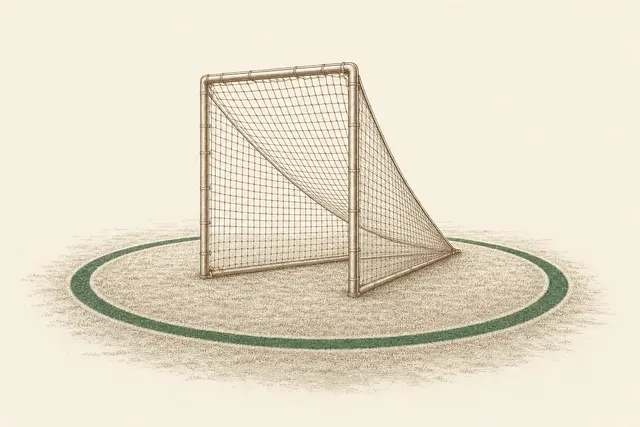
Around these sit the lines on the pitch. In field lacrosse the restraining lines divide the ends from the midfield, and the wing lines mark where midfielders wait at the face-off. Plate I shows both.
For anyone working out how to play lacrosse, the stick comes first: catching, cradling the ball in the pocket while running, and passing on the move. The rules guide takes the restart, the crease, the shot clock and the fouls one at a time, and compares the four formats side by side.
Where can you play lacrosse in the UK?
In the UK, clubs and university teams play the women's game and men's field lacrosse in organised leagues, and mixed lacrosse and box lacrosse have their own competitions. The leagues page sets out how the men's, women's and university competitions are organised in England.
The most reliable route to a club is the organisation that runs the sport. England Lacrosse, which runs the sport in England, keeps a club finder on its own site, with each club's contact details.
Universities are a common entry point for adults. How to play lacrosse as an adult in the UK depends on where you live and which format suits you, and the where to play page sets out each route, including Scotland and Wales.
Scotland and Wales have their own associations, Lacrosse Scotland and Wales Lacrosse, each with a list of clubs and leagues. University lacrosse runs through British Universities and Colleges Sport: England Lacrosse reports more than 230 teams in 15 women's and 11 men's leagues, with league play from late September to March.
Adult lacrosse in England runs on three tracks rather than one national league: regional associations that run the club leagues, British Universities and Colleges Sport for students, and a mixed league run by England Lacrosse. Some of the regional bodies are old. The South of England Men's Lacrosse Association gives its founding date as 15 March 1882. Club seasons run from September or October to April, with summer tournaments around them.
Where did lacrosse come from? A short history
Lacrosse began as a game of the Indigenous peoples of North America. World Lacrosse describes it as originating in Native American tribes and first known as stickball, and Lacrosse Canada as a sacred game played for spiritual, ceremonial and diplomatic purposes. French observers gave it the name it carries today.
The modern rules came out of Montreal. A Canadian dentist, William George Beers, founded the Montreal Lacrosse Club in 1856, and a decade later he drew up rules that cut the number of players and introduced a rubber ball and a redesigned stick. Exhibition games brought the game to England in 1867.
- 1856Montreal Lacrosse Club founded
- 1867Exhibition games in England
- 1912Ladies Lacrosse Association formed
- 1978Stockport hosts the men's World Championship
Women's lacrosse took root early in Britain: a Ladies Lacrosse Association followed in 1912, and the first women's international matches were played in 1913. England has since hosted world championships for both men and women, from Stockport in 1978 to Guildford in 2017. The history pages and the record of England's national teams go into the detail.
England has been part of the international game from the start. The first men's world championship, in Toronto in 1967, was a four-team invitational, and England has since hosted the men's event three times: Stockport in 1978, Bury in 1994 and Manchester in 2010. In the women's championships England has won two silver and five bronze medals since 1982, the most recent bronzes at Guildford in 2017 and at Towson in 2022, though no England side has yet won a world title.
Is lacrosse an Olympic sport? From 1904 to LA28
Lacrosse is not new to the Olympic Games: two medal appearances, three as a demonstration sport, and now a return.
- 1904Medal sport at the St Louis Games
- 1908Medal sport again, in London
- 1928–48Demonstration sport in 1928, 1932 and 1948
- 2023IOC adds men's and women's Sixes, 16 October
- 2028Sixes at the Los Angeles Games, July
The IOC added lacrosse to the LA28 programme at its session in Mumbai on 16 October 2023, in the Sixes format for both men and women. The Los Angeles Games run in July 2028. Six a side, a 70 × 36 m pitch and a 30-second shot clock make a short game that is simple to stage.
Great Britain took part in the 1908 tournament in London, losing the final to Canada and taking silver; Olympedia records the score as 14–10 from the official report. That was the last time lacrosse awarded Olympic medals until the Sixes events planned for 2028.
Guildford, 2017: the World Cup in England
The 2017 Women's Lacrosse World Cup was held at Surrey Sports Park in Guildford in July 2017. The United States beat Canada 10–5 in the final on 22 July, and England took the bronze medal.
The road to Los Angeles runs through three stages, as World Lacrosse set them out in July 2026. Continental Sixes championships between September and December 2026 send 16 nations per gender on, the first World Lacrosse Sixes Championships in October 2027 send five teams per gender to Los Angeles, and a final qualifying tournament in early 2028 completes the field of six. The United States qualifies as host, provided it takes part in the Pan-American and world championships.
The only Olympic medal tournament played in the United States so far, at St Louis in 1904, ran between 2 and 7 July at Francis Field. Three club teams took part, two from Canada and one from St Louis, and the Winnipeg Shamrocks beat the St Louis Amateur Athletic Association 8–2 in the final, according to Olympedia.
When is the lacrosse season? The year in UK time
Most professional lacrosse is played in North America, so following it from the UK is a matter of knowing when each competition runs. The calendar below sets the year out month by month, with the current month marked in UK time.
Recent seasons give a sense of the rhythm. The 2025–26 National Lacrosse League season opened on 28 November 2025 and its Finals ended on 17 May 2026. The Premier Lacrosse League opened its 2026 season on 8 to 10 May and played its Championship on 18 to 20 September. The NCAA Division I finals fall on Memorial Day weekend: 24 May 2026 for the women's final, 25 May for the men's. North American start times usually land in the UK evening or overnight.
Today in the UK
In season this month
Olympic Sixes
Solid band: season. Hatched: finals or Games. Striped: opening weeks or pre-season series. Exact dates follow each league's fixture list.
Questions people ask about lacrosse
What is lacrosse?
Lacrosse is a team sport played with a netted stick and a solid rubber ball. Players catch, carry and pass the ball with the stick and score by shooting it into the opposing goal.
How many players are on a lacrosse team?
Part of what is lacrosse is the choice of format, and the team size follows it: 10 a side in men's field lacrosse, up to 10 in women's field lacrosse under international rules (12 in the US college game), six on the floor in box lacrosse and six a side in Sixes.
Is lacrosse an Olympic sport?
It was a medal sport in 1904 and 1908. Lacrosse returns in the Sixes format, for men and women, at the Los Angeles Games in July 2028.
What is the difference between box and field lacrosse?
Field lacrosse is played outdoors on a full-size pitch with 10 a side in the men's game. Box lacrosse is played indoors inside dasher boards with six on the floor and a 30-second shot clock, which makes it tighter and faster.
How long is a lacrosse game?
Under World Lacrosse rules, men's and women's field lacrosse and box lacrosse are played in four 15-minute quarters. Sixes, the LA28 format, has four quarters of eight minutes. The rules guide compares the formats.
Is lacrosse a contact sport?
It depends on the format. Stick checks are part of every format, and the amount of legal body contact varies, with the women's game the most restrictive. Dangerous checks and contact to the head are penalised in all of them.
What is mixed lacrosse?
A field format for teams of men and women, built on the women's rules. England Lacrosse's mixed rules allow at most five players of either gender on the field, permit only women's sticks, use a running clock and give mandatory cards for rough checks, checks to the head and deliberate physical fouls.
Where can I play lacrosse in the UK?
England Lacrosse, which runs the sport in England, has a club finder on its site. Universities are another common starting point for adult beginners.